
Beyond Academics: Life Skills Students Learn at The CGR Academy
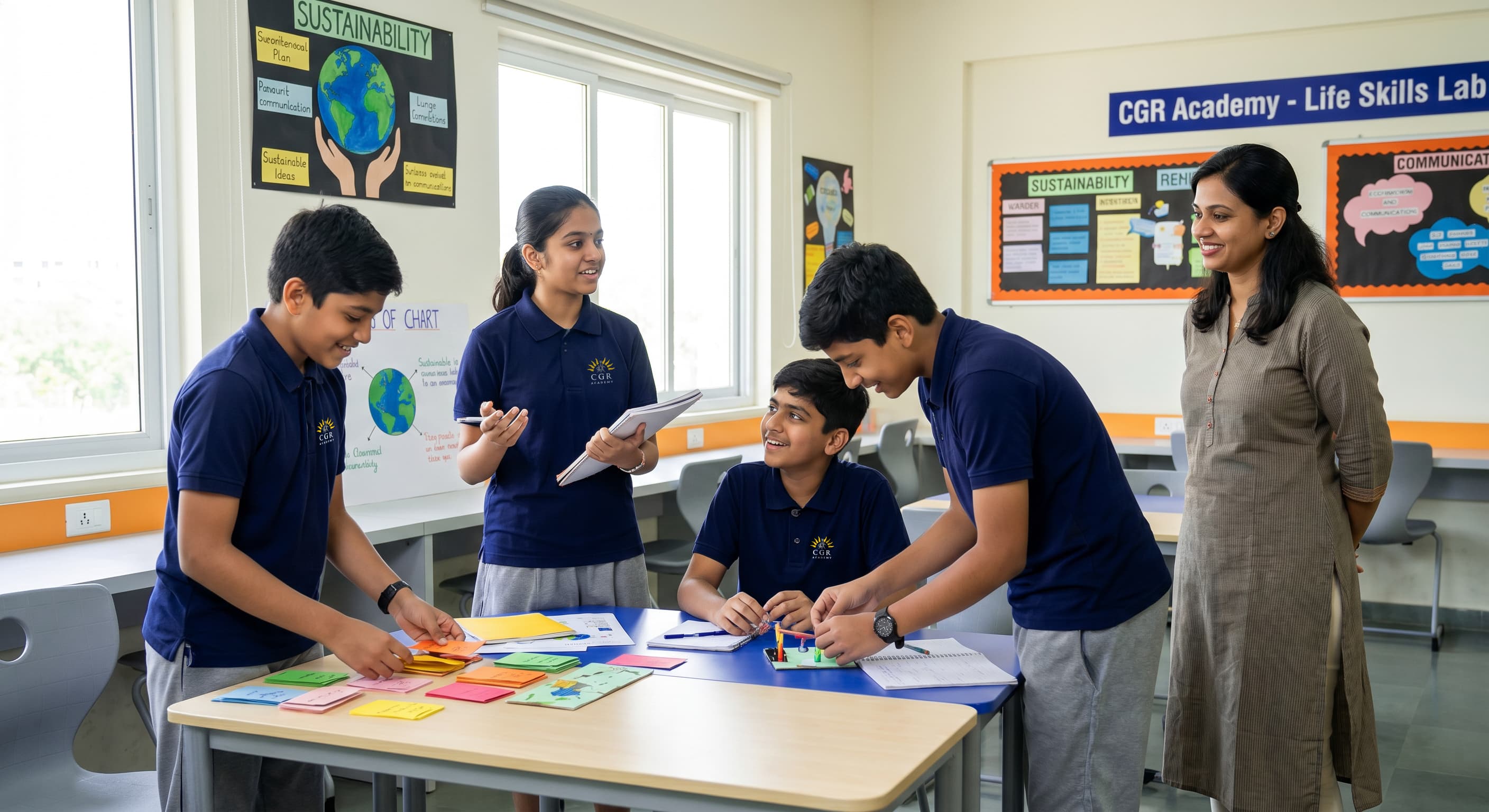
There is a moment in almost every classroom when a student asks a question that isn’t really in the textbook. Sometimes it starts with “why,” sometimes with “what if.” Those moments matter more than they seem to. They show that learning is not just about remembering answers but about trying to make sense of the world. At CGR Academy, we have come to believe that academics alone don’t stay with a child for very long unless they are tied to something real. Facts are important, of course, and a strong academic foundation matters. But the habits students form while learning often stay longer than the lessons themselves. That is where life skills education begins to take shape, quietly and naturally, inside everyday school life. It isn’t treated like a separate subject. Instead, it appears in small ways, in conversations, in teamwork, and sometimes even in mistakes.
Curiosity As A Starting Point
Children are naturally curious. They ask questions without worrying whether the question sounds smart. Over time, though, many students begin to hesitate. They start looking for the “right” answer instead of exploring different ones. We try to hold on to that early curiosity. Our blended approach, which combines structured learning with inquiry-based methods, allows students to explore ideas while still building a strong academic base. This balance is part of what people look for when searching for Cambridge schools in Kollur, but what matters more to us is what happens inside the classroom. When students are encouraged to ask questions, they begin to trust their own thinking. That trust slowly becomes confidence. Confidence then becomes independence. It doesn’t happen all at once, and it doesn’t look the same for every child, but the process is always visible if someone is paying attention.
Learning To Work With Others
Some lessons can only be learned around other people. Group projects, clubs, and activities often look simple from the outside, but they ask students to do something that isn’t always easy. They have to listen, explain, disagree, and sometimes compromise. In those moments, students begin to understand that their ideas are not the only ones in the room. They learn how to express themselves clearly and how to hear someone else out. These are small social skills, but they shape the way students handle situations later in life. Through clubs and shared activities at CGR Academy, students discover abilities they didn’t know they had. A quiet student might find a voice in theatre. Another might learn patience on the sports field. These experiences slowly build value, education, and life skills, not through lectures but through lived experience.
Confidence Through Exploration
Confidence doesn’t usually come from being told to feel confident. It grows from trying something unfamiliar and realizing it wasn’t impossible after all. Our campus spaces at CGR Academy are designed with this in mind. Labs, activity rooms, sports areas, and creative spaces give students chances to understand different interests. Sometimes a student who struggles in a traditional classroom setting becomes completely focused during a hands-on activity. It’s a reminder that learning has many forms. Technology also plays a role here. When students interact with simulations or experiment with new tools, they begin to see learning as something active rather than passive. They are not just receiving information. They are working with it. This kind of environment is part of why we are often mentioned among the best CBSE schools in Velimela, but the real value is in how students grow within these spaces, not just in how the spaces look.
Emotional Growth Matters Too
Academic progress is easy to measure. Marks and grades make it visible. Emotional growth is quieter. It appears in the way a student handles disappointment or the way they respond to a challenge. We have noticed that students do better when they feel understood. A strong connection between teachers and students creates a sense of safety, and that safety allows students to take risks in their learning. Programs that focus on emotional awareness help students recognize their feelings and respond to them in healthy ways. This might sound simple, but it can change how students approach both school and life. They learn that frustration is part of learning, not a sign that they should stop trying. Over time, students begin to manage their time better, communicate more clearly, and handle pressure with a bit more calm. These are quiet changes, but they stay with them.
Preparing For Real Life
There is always a question in the background of education. It isn’t asked directly very often, but it’s always there. The question is whether school is preparing students for the world beyond it. We think about this often. Academic knowledge is important, but real life asks for more than that. It asks for decision-making, adaptability, and resilience. It asks for people who can think for themselves while still working with others. That is why we try to connect learning with real situations whenever possible. Whether it is through projects, discussions, or practical activities, students begin to see how their learning applies outside the classroom. Slowly, they begin to understand that education is not just preparation for exams. It is preparation for life.
Final Thoughts
When people look at a school from the outside, they often see results first. Scores, achievements, and facilities are easy to notice. What takes longer to see is how students change during their time there. At CGR Academy, we see that change in small ways. A hesitant student speaking up. A group solving a problem together. A child trying again after failing the first time. These moments don’t usually appear in report cards, but they matter. They show that learning is happening on more than one level. Academics will always be important, and they should be. But alongside them, students are learning how to think, how to relate to others, and how to handle the world around them. That combination is what makes education feel complete. And in the end, those lessons are often the ones that last the longest.